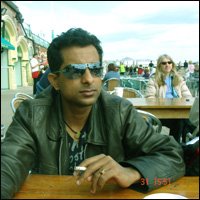
and there - between the park and the flat with no number, he was many months drifted. you could tell by the hunger in his eyes, by the way his hands held. or his fingers felt,
where once there was something.
a ring, perhaps.
it was an evening in july, and the sky had come down upon the rooftops like a hundred black helicopters.
Monday, May 11, 2009


Sunday, May 10, 2009
before the rains, 1
this man i know lives in a flat like mine, across the park with the white temple-flower trees and the water-pump station. he's got the place on a one-year lease,
he says. he says he'd messed up something - back in the old days when he still had a woman - a home - and was not quite so alone. in delhi
he says. he says he'd messed up something - back in the old days when he still had a woman - a home - and was not quite so alone. in delhi
Friday, March 27, 2009
English! Come home to mama!
The apparent purpose of translation is to convey truthfully in one language what has already been conveyed in another. The politics behind the purpose, a most fiercely discussed contemporary affair, is neither my area of expertise nor the purpose of this essay. I shall, instead, discuss translation as a revitalising and a significant shaping influence on language and literature.
The most crucial of the revitalising influences of translations lie in its ability to create what I’d like to term the ‘first utterance’ affect. By ‘first utterance’ affect I mean the use of a word, a combination of words, in a manner that is reminiscent of that phase of language when the metaphoric potential of an expression is still relatively uncharted as its meanings are not yet fixed across multiple contexts. Since it is often difficult to find equivalent words while translating, the equivalent phrase, neologism or compound expression manufactured to approximate the original word, tends to create the ‘first utterance’ affect in the language it is carved from.
Girdhar Rathi and Mahendra Bhalla have translated Bhalla’s Hindi story Kuttegiri into English (published in Indian Literature). While I haven’t had opportunity to read the Hindi ‘original’, the title of the translated version, ‘Doggery’, should sufficiently illustrates my point about ‘first utterance affect’. The translators explain the term in a rather curious footnote: “In India most dogs are stray. The term (here it is not clear whether they’re referring to Kuttegiri or Doggery) has come out of their way of existence.”
True to the promise of the footnote, a great deal of Doggery does stray into the story. The narrative opens with a declaration made by the narrator’s friend – “I import dry fruits from Pakistan. That keeps me going. As for the rest, well, I’m free to indulge in my doggery.” In another dialogue between the doggers, the word is re-constructed:
“We human beings have just one Coffee House, but these parakeets –they have by the thousands, I bet...”
“Doggery?” I needled him.
“They are all real doggers…and not just them. All birds.” He insisted.
“Then why not call it parakeetery?”
“Do, if you wish. However, doggery is the thing. Dogs are dogs even if they live in a city.”
The term is further fleshed out later in the story: “Suddenly it occurred to me that he was making a fool of me, and that he had been doing this all along. Always cheating me – drinking coffee and whisky out of me, all under the guise of a feigned submission. If that was part of his doggery, he was certainly a successful dogger.”
The use of the term Doggery is possible only because it was being translated from the Hindi kuttegiri, a term in circulation; if one were for a moment to assume that the story was not a translation, that the writer were penning it in English as the original, a whole set of paradigms involving ‘doggery’ would change. Doggery, to begin with might be replaced by loafing, or described through a phrase or description where loafing is the functional word. Doggery, with all its associations of life in the alleys, stray dogs, cunning, sexual scavenging, is less likely to seek birth in a work that is not a translation because the local social context within which ‘doggery’ functions precludes English. If kuttegiri lived long enough, and got translated more often, not only will loafing have a more lively bastard sibling, but doggery is likely to inject a new spirit into an idea that is now socially passé.
My experience with translating texts, especially ones that are removed from contemporary language not only by linguistic difference but also by time and taste, has led me to that oft acknowledged by-product of the process of translation – rediscovery and refashioning of literary form and the reconfiguring of contemporary sensibilities, however transitory and ephemeral they might be and however limited be their scope of influence. My interest is definitely not something novel. The blank verse owes its pedigree to tinkering with translations of the Greek Alexandrian line, the hexameter. The English sonnet, the villanelle, the ode, the eclogue – all were not native to the English tongue at the time they were fashioned. It was a combination of an active interest in the Latin and Greek forms and an ongoing process of translation from these languages into English and the consequent formal adjustments that gave English language more than half of its standard, canonised literary forms.
On wonders, however, why then, has English not been able to fashion in its three hundred odd years of interaction with languages of India, a single recognisable form? Perhaps, it has to do with the difference in the relationship that English shared with Latin and Greek, from the relationship it shares with Indian tongues. Perhaps the time was not ripe. But the possibilities are aplenty, and it is bound to happen when English transcends its function as a language of utilitarian functions and begins to seep into the collective consciousness of India, the moment we have sufficient versions of English that correspond to the innumerable micro-communities that make up the subcontinent.
There have been tentative beginnings. Rukmini Bhai Naiyar’s attempts at an English shloka, are delightful in the manner they mirror the Sanskrit form. Rukmini’s versions too, like the best shlokas in Sanskrit, lend different meanings if split at different points of the conjoint compound words; they are essentially based on a quantitative meter, and don’t rhyme as their Sanskrit originals don’t. Where they probably fail is in their inability to duplicate the compressive power of the shloka and their lack of courage to substitute ‘compression’ with a new function or functions.
Since, Rukmini’s English shlokas are not strictly speaking translations, here’s an example of a translation that learns from her formal experiments. The Sanskrit original, is probably one the best known shlokas from the Gita:
Nainum chindanti shastrani, nainamdahati pavakaha
Na chainam kledyantyapo, na shoshayatihi marutaha
Nevershallitshallnevernowordsever
Shallneverknowhurtshallitnever shrivelinnoflaming
Fire. shallitneverwetineverwetwater
Noraridairdryitshallnevernever
But there are other forms that are begging to be looked at: the chaupai, the epigrammatic doha (Pope would have flipped on it!), and in prose-poetry the paheli. Another interesting form from Tamil literature, an oral tradition of performed poetry that is essentially ‘travelogues in verse’, appears to hold great promise for anyone who has the courage to seize upon its potential as a literary form. I do not claim these as forms that will remain, that are sure to offer definite answers to how a fledgling Indian English can grow, but they are sure to point out directions for its growth and appear the best way to bridge the gap between a foreign tongue and an appropriated one.
My own translations from Sanskrit and Hindi literature have, I confess, offered me far more by way of formal possibilities and challenges than any contemporary work in English has. The forms are startlingly original. Had the author/authors of the Kathopanishada approached a modern publisher, he/she/they would have faced one pointed question – What kind of work is this? As a translator, I ask myself, what the answer should be? These are not extended poems, though they are in verse; these are not short stories, though they are stories too; and of course these are not just philosophic aphorisms and ruminations though there is a healthy matrix of both.
The verse form used in Taitriyopanishada, ‘the anuvakaha’ anticipates the modern prose poem in its terseness, its alternating use of heavily end-stopped lines and precariously incomplete sounding endings. Sample this:
Haa vu, Haavu, Haa vu!
I am anna, I am anna, I am anna.
I am annada I am annada I am annada.
I am the maker of shlokas, the maker of shloklas.
I am the first born among the seasons.
Before the gods out of the belly-button.
He who gives me away
Protects me.
I am anna who eats the eater.
I have contempt for the world.
- Taitrriyopanshida, Bhrigu Valli, Dashama Anuvakaha
And this
When man will be able to wrap the sky
Like skin around him,
Then,
Even without knowing gods,
Pain and grief will be destroyed.
- Shwetaashwataropanishad, Shashtha Adhyaya
And this
I am the bearer of the tree.
My fame is like the mountains.
High and pure of men
I am my own nectar.
The effulgent flow.
- - Taitrriyopanshida, Shiksha Valli, Dashama Anuvakaha
My translations of these verses, the anuvakaha, led me to fashion a corresponding English rhythm that was closer to the contemporary style, less earnest in tone, but one that retained the incantatory, prose-poem like sounds.
I am well versed in the rites of the visit.
I have stories and tales. I have talk.
I have he wisdom of laughter.
I have the wit of a smile.
I have the measure of the roads.
I know m city.
I am curious. I speak with strangers.
I listen to friends. I have no foes.
I balance my tongue with my ear
I balance my eye with my nose.
I am prepared. Always.
I wear light clothes.
I wear the fragrances of flowers on my sleeves.
I keep my feet clean.
I keep my coins in my purse.
I keep my hands in my purse alone.
Where I am invited there I go
And the bell rings always
When I am come at the expected time,
In my ladies chamber.
Over steps that lead to the shrine.
- From Atithi, (unpublished work)
In addition to the vigour that re-discovery of forms through translation infuses into a literature, translations also contribute in fashioning a new rhetoric of the language, first within literature, and gradually even in speech. My Penguin edition of Bhagwat Gita, a translation by Juan Mascaro opens thus:
“On the field of Truth, on the battle-field of life, what came to pass, Sanjaya, when my sons and their warriors faced those of my brother Pandu?”
Now, this is a translation of the celebrated opening:
“Dharmakshetrey, kurukshetrey, samveta yuyutsava,
mamakaha pandavascheyva kim kurvata sanjaya”
I do not pretend to stand judge on the quality of the translation; each translator has his own parameters of translation and seeks a different kind of truth-telling in the translation. I would, however, like to point out what gets left out, what added, and how the very manner of telling gets affected by the shift in language, and how this change in the manner-of-telling can affect subsequent literatures being produced in that language even if they are not translations.
In the above example there are several things happening: for one, the translator chooses prose over verse. The result is a certain flattening of the declamatory tone – not necessarily a negative as the English language is not given to a rich hyperbolic poetic tone (Swinburne was crucified for it, and Dylan Thomas escaped because he died too soon). The translation also loses out on the literal meaning rooted in the story of the Mahabharata, when it attempts to reach into the philosophical basis: “the field of truth” and Dharmakshetrey are not synonymous; while “the field of truth” points only towards the metaphysical battlefield of what is right and what is not, “Dharmakshetrey” signifies much more – duty, action and responsibility. Similarily, “the battle-field of life” misses out on Kurukshetra as a tangible geographical entity entirely. The term “yuyutsava” that means an anxious eagerness to do battle, so crucial to the opening scene of the Gita, is entirely left out for the sake of brevity and simplicity (perhaps).
Yet, the translation fashions a new rhetoric for English language in India. It sidles away from the heavy-laden-with-multiple-meanings construction to a simple more prosaic one where the metaphysical and the physical are kept neatly apart. It chose, however to retain a version of ‘elevated speech’ that is created by combining clichés from ‘oriental stories’ like ‘the field of Truth’, ‘the battle-field of life’ and ‘what came to pass’. Once the translator is better aligned with the contemporary post-modern ear, one is more likely to get a translation that reads like this:
“In the battlefield of Kurukshetra and Dharma, collected, arrayed, eager to battle, my sons and Pandu’s boys! Sanjay, what are they doing?”
Raja Rao’s Kanthapura benefits immensely from a combination of standard English and English usage that came into circuit and became acceptable only by the influence of translations into English of Indian works. Sentences that could never be conceived of in English except as translations from another tongue dot Raja Rao’s narrative and consciously help achieve two things: a) communicate the fact that while the language is English, the context, the narrator and the speakers are not speaking in English, and b) to thus attempt to synthesise an Indian English that could be read without their British, American or other foreign associations. Thus, the opening
“Our village – I don’t think you have ever heard about it – Kanthapura is its name, and it is in the province of Kura. High on the Ghats is it, high up the steep mountains that face the cool Arabian seas, up the Malabar coast is it, up up Mangalore and Puttur and many a centre of cardamom and coffee, rice and sugarcane.”
Now, where the “is it” and the “is its name” comes from, and where the seamless narrative will become clear from the following translation of the “translated tongue”:
“Humaara ganv (a sigh here) – mujhey nahin lagta tumney uskey barey mein suna hoga – Kanthapura hai uska naam, aur woh tehsil kura mein parta hai. Unchey Ghat par basa hai who, unchey paharon par jo samandar ko muh kiya hua hai, Malabar key tat sey uttar ko hai woh, Mangalore she bhi aagey, Puttur she bhi aagey aur…”
It’s a crude translation, and ideally should have been in tamil I think, but Hindi will do here to illustrate my point. The only reason why Raja Rao was able to use an alternative rhetoric and deviations from standard syntax is due to the pre-existing “translation English” that is recognised as “Indian” as against other standard forms of English.
Sometimes, this “translation tongue” can form a separate idiom by itself, almost a sub-language, a little like the Anglo-Indian community in India that can choose to lay claim to a dual parentage, but almost always, tend to align themselves to one or the other. Here’s are two amusing examples of this “translation tongue” that could easily form the basis of another poem on Pushpa T:
“Desirous of sustaining the life of his wife, as the month of Sravana was drawing nigh, and therefore intending to send tidings of his welfare (to her) by the cloud, the Yaksha (himself) delighted, bade welcome, in words full of affection, to the cloud to whom an offering of fresh Kutaja flowers had been made.”
- Cantos 4, Purvamegha, Meghdutam, The Meghduta of Kalidasa, Edited by Gopal Raghunath Nandargikar
And, in case it appears an exception, or a case that afflicts only Indian translators, here’s another:
With relish due ambrosia, a dog eats a meatless bone,
Wormy, spittle-wet, putrid, and vile. He would eat
Without qualm even if he saw the lord of gods nearby.
A wretch does not assess the poverty of his lot.
- Among Fools and Kings, Poem 30, by Bhartrihari, translated by Barbara Stoler Miller
These, obviously are no Ezra Pounds at work. But if they were, perhaps, English would have interiorised the shloka and the rasa, the ghazal and the nazm, as much as it has the Haiku. If English literature is to come home to India, creative translations, even mistranslations, if they are better than the ones I have just quoted, will need to lead the way. It is common knowledge that languages are always rooted to experience native to their people, but it is also a fact that languages change, grow and evolve, that when a word is appropriated by a powerful people, it will lend the meaning it is ascribed. If that were not the case, India would have been known by a different name.
The most crucial of the revitalising influences of translations lie in its ability to create what I’d like to term the ‘first utterance’ affect. By ‘first utterance’ affect I mean the use of a word, a combination of words, in a manner that is reminiscent of that phase of language when the metaphoric potential of an expression is still relatively uncharted as its meanings are not yet fixed across multiple contexts. Since it is often difficult to find equivalent words while translating, the equivalent phrase, neologism or compound expression manufactured to approximate the original word, tends to create the ‘first utterance’ affect in the language it is carved from.
Girdhar Rathi and Mahendra Bhalla have translated Bhalla’s Hindi story Kuttegiri into English (published in Indian Literature). While I haven’t had opportunity to read the Hindi ‘original’, the title of the translated version, ‘Doggery’, should sufficiently illustrates my point about ‘first utterance affect’. The translators explain the term in a rather curious footnote: “In India most dogs are stray. The term (here it is not clear whether they’re referring to Kuttegiri or Doggery) has come out of their way of existence.”
True to the promise of the footnote, a great deal of Doggery does stray into the story. The narrative opens with a declaration made by the narrator’s friend – “I import dry fruits from Pakistan. That keeps me going. As for the rest, well, I’m free to indulge in my doggery.” In another dialogue between the doggers, the word is re-constructed:
“We human beings have just one Coffee House, but these parakeets –they have by the thousands, I bet...”
“Doggery?” I needled him.
“They are all real doggers…and not just them. All birds.” He insisted.
“Then why not call it parakeetery?”
“Do, if you wish. However, doggery is the thing. Dogs are dogs even if they live in a city.”
The term is further fleshed out later in the story: “Suddenly it occurred to me that he was making a fool of me, and that he had been doing this all along. Always cheating me – drinking coffee and whisky out of me, all under the guise of a feigned submission. If that was part of his doggery, he was certainly a successful dogger.”
The use of the term Doggery is possible only because it was being translated from the Hindi kuttegiri, a term in circulation; if one were for a moment to assume that the story was not a translation, that the writer were penning it in English as the original, a whole set of paradigms involving ‘doggery’ would change. Doggery, to begin with might be replaced by loafing, or described through a phrase or description where loafing is the functional word. Doggery, with all its associations of life in the alleys, stray dogs, cunning, sexual scavenging, is less likely to seek birth in a work that is not a translation because the local social context within which ‘doggery’ functions precludes English. If kuttegiri lived long enough, and got translated more often, not only will loafing have a more lively bastard sibling, but doggery is likely to inject a new spirit into an idea that is now socially passé.
My experience with translating texts, especially ones that are removed from contemporary language not only by linguistic difference but also by time and taste, has led me to that oft acknowledged by-product of the process of translation – rediscovery and refashioning of literary form and the reconfiguring of contemporary sensibilities, however transitory and ephemeral they might be and however limited be their scope of influence. My interest is definitely not something novel. The blank verse owes its pedigree to tinkering with translations of the Greek Alexandrian line, the hexameter. The English sonnet, the villanelle, the ode, the eclogue – all were not native to the English tongue at the time they were fashioned. It was a combination of an active interest in the Latin and Greek forms and an ongoing process of translation from these languages into English and the consequent formal adjustments that gave English language more than half of its standard, canonised literary forms.
On wonders, however, why then, has English not been able to fashion in its three hundred odd years of interaction with languages of India, a single recognisable form? Perhaps, it has to do with the difference in the relationship that English shared with Latin and Greek, from the relationship it shares with Indian tongues. Perhaps the time was not ripe. But the possibilities are aplenty, and it is bound to happen when English transcends its function as a language of utilitarian functions and begins to seep into the collective consciousness of India, the moment we have sufficient versions of English that correspond to the innumerable micro-communities that make up the subcontinent.
There have been tentative beginnings. Rukmini Bhai Naiyar’s attempts at an English shloka, are delightful in the manner they mirror the Sanskrit form. Rukmini’s versions too, like the best shlokas in Sanskrit, lend different meanings if split at different points of the conjoint compound words; they are essentially based on a quantitative meter, and don’t rhyme as their Sanskrit originals don’t. Where they probably fail is in their inability to duplicate the compressive power of the shloka and their lack of courage to substitute ‘compression’ with a new function or functions.
Since, Rukmini’s English shlokas are not strictly speaking translations, here’s an example of a translation that learns from her formal experiments. The Sanskrit original, is probably one the best known shlokas from the Gita:
Nainum chindanti shastrani, nainamdahati pavakaha
Na chainam kledyantyapo, na shoshayatihi marutaha
Nevershallitshallnevernowordsever
Shallneverknowhurtshallitnever shrivelinnoflaming
Fire. shallitneverwetineverwetwater
Noraridairdryitshallnevernever
But there are other forms that are begging to be looked at: the chaupai, the epigrammatic doha (Pope would have flipped on it!), and in prose-poetry the paheli. Another interesting form from Tamil literature, an oral tradition of performed poetry that is essentially ‘travelogues in verse’, appears to hold great promise for anyone who has the courage to seize upon its potential as a literary form. I do not claim these as forms that will remain, that are sure to offer definite answers to how a fledgling Indian English can grow, but they are sure to point out directions for its growth and appear the best way to bridge the gap between a foreign tongue and an appropriated one.
My own translations from Sanskrit and Hindi literature have, I confess, offered me far more by way of formal possibilities and challenges than any contemporary work in English has. The forms are startlingly original. Had the author/authors of the Kathopanishada approached a modern publisher, he/she/they would have faced one pointed question – What kind of work is this? As a translator, I ask myself, what the answer should be? These are not extended poems, though they are in verse; these are not short stories, though they are stories too; and of course these are not just philosophic aphorisms and ruminations though there is a healthy matrix of both.
The verse form used in Taitriyopanishada, ‘the anuvakaha’ anticipates the modern prose poem in its terseness, its alternating use of heavily end-stopped lines and precariously incomplete sounding endings. Sample this:
Haa vu, Haavu, Haa vu!
I am anna, I am anna, I am anna.
I am annada I am annada I am annada.
I am the maker of shlokas, the maker of shloklas.
I am the first born among the seasons.
Before the gods out of the belly-button.
He who gives me away
Protects me.
I am anna who eats the eater.
I have contempt for the world.
- Taitrriyopanshida, Bhrigu Valli, Dashama Anuvakaha
And this
When man will be able to wrap the sky
Like skin around him,
Then,
Even without knowing gods,
Pain and grief will be destroyed.
- Shwetaashwataropanishad, Shashtha Adhyaya
And this
I am the bearer of the tree.
My fame is like the mountains.
High and pure of men
I am my own nectar.
The effulgent flow.
- - Taitrriyopanshida, Shiksha Valli, Dashama Anuvakaha
My translations of these verses, the anuvakaha, led me to fashion a corresponding English rhythm that was closer to the contemporary style, less earnest in tone, but one that retained the incantatory, prose-poem like sounds.
I am well versed in the rites of the visit.
I have stories and tales. I have talk.
I have he wisdom of laughter.
I have the wit of a smile.
I have the measure of the roads.
I know m city.
I am curious. I speak with strangers.
I listen to friends. I have no foes.
I balance my tongue with my ear
I balance my eye with my nose.
I am prepared. Always.
I wear light clothes.
I wear the fragrances of flowers on my sleeves.
I keep my feet clean.
I keep my coins in my purse.
I keep my hands in my purse alone.
Where I am invited there I go
And the bell rings always
When I am come at the expected time,
In my ladies chamber.
Over steps that lead to the shrine.
- From Atithi, (unpublished work)
In addition to the vigour that re-discovery of forms through translation infuses into a literature, translations also contribute in fashioning a new rhetoric of the language, first within literature, and gradually even in speech. My Penguin edition of Bhagwat Gita, a translation by Juan Mascaro opens thus:
“On the field of Truth, on the battle-field of life, what came to pass, Sanjaya, when my sons and their warriors faced those of my brother Pandu?”
Now, this is a translation of the celebrated opening:
“Dharmakshetrey, kurukshetrey, samveta yuyutsava,
mamakaha pandavascheyva kim kurvata sanjaya”
I do not pretend to stand judge on the quality of the translation; each translator has his own parameters of translation and seeks a different kind of truth-telling in the translation. I would, however, like to point out what gets left out, what added, and how the very manner of telling gets affected by the shift in language, and how this change in the manner-of-telling can affect subsequent literatures being produced in that language even if they are not translations.
In the above example there are several things happening: for one, the translator chooses prose over verse. The result is a certain flattening of the declamatory tone – not necessarily a negative as the English language is not given to a rich hyperbolic poetic tone (Swinburne was crucified for it, and Dylan Thomas escaped because he died too soon). The translation also loses out on the literal meaning rooted in the story of the Mahabharata, when it attempts to reach into the philosophical basis: “the field of truth” and Dharmakshetrey are not synonymous; while “the field of truth” points only towards the metaphysical battlefield of what is right and what is not, “Dharmakshetrey” signifies much more – duty, action and responsibility. Similarily, “the battle-field of life” misses out on Kurukshetra as a tangible geographical entity entirely. The term “yuyutsava” that means an anxious eagerness to do battle, so crucial to the opening scene of the Gita, is entirely left out for the sake of brevity and simplicity (perhaps).
Yet, the translation fashions a new rhetoric for English language in India. It sidles away from the heavy-laden-with-multiple-meanings construction to a simple more prosaic one where the metaphysical and the physical are kept neatly apart. It chose, however to retain a version of ‘elevated speech’ that is created by combining clichés from ‘oriental stories’ like ‘the field of Truth’, ‘the battle-field of life’ and ‘what came to pass’. Once the translator is better aligned with the contemporary post-modern ear, one is more likely to get a translation that reads like this:
“In the battlefield of Kurukshetra and Dharma, collected, arrayed, eager to battle, my sons and Pandu’s boys! Sanjay, what are they doing?”
Raja Rao’s Kanthapura benefits immensely from a combination of standard English and English usage that came into circuit and became acceptable only by the influence of translations into English of Indian works. Sentences that could never be conceived of in English except as translations from another tongue dot Raja Rao’s narrative and consciously help achieve two things: a) communicate the fact that while the language is English, the context, the narrator and the speakers are not speaking in English, and b) to thus attempt to synthesise an Indian English that could be read without their British, American or other foreign associations. Thus, the opening
“Our village – I don’t think you have ever heard about it – Kanthapura is its name, and it is in the province of Kura. High on the Ghats is it, high up the steep mountains that face the cool Arabian seas, up the Malabar coast is it, up up Mangalore and Puttur and many a centre of cardamom and coffee, rice and sugarcane.”
Now, where the “is it” and the “is its name” comes from, and where the seamless narrative will become clear from the following translation of the “translated tongue”:
“Humaara ganv (a sigh here) – mujhey nahin lagta tumney uskey barey mein suna hoga – Kanthapura hai uska naam, aur woh tehsil kura mein parta hai. Unchey Ghat par basa hai who, unchey paharon par jo samandar ko muh kiya hua hai, Malabar key tat sey uttar ko hai woh, Mangalore she bhi aagey, Puttur she bhi aagey aur…”
It’s a crude translation, and ideally should have been in tamil I think, but Hindi will do here to illustrate my point. The only reason why Raja Rao was able to use an alternative rhetoric and deviations from standard syntax is due to the pre-existing “translation English” that is recognised as “Indian” as against other standard forms of English.
Sometimes, this “translation tongue” can form a separate idiom by itself, almost a sub-language, a little like the Anglo-Indian community in India that can choose to lay claim to a dual parentage, but almost always, tend to align themselves to one or the other. Here’s are two amusing examples of this “translation tongue” that could easily form the basis of another poem on Pushpa T:
“Desirous of sustaining the life of his wife, as the month of Sravana was drawing nigh, and therefore intending to send tidings of his welfare (to her) by the cloud, the Yaksha (himself) delighted, bade welcome, in words full of affection, to the cloud to whom an offering of fresh Kutaja flowers had been made.”
- Cantos 4, Purvamegha, Meghdutam, The Meghduta of Kalidasa, Edited by Gopal Raghunath Nandargikar
And, in case it appears an exception, or a case that afflicts only Indian translators, here’s another:
With relish due ambrosia, a dog eats a meatless bone,
Wormy, spittle-wet, putrid, and vile. He would eat
Without qualm even if he saw the lord of gods nearby.
A wretch does not assess the poverty of his lot.
- Among Fools and Kings, Poem 30, by Bhartrihari, translated by Barbara Stoler Miller
These, obviously are no Ezra Pounds at work. But if they were, perhaps, English would have interiorised the shloka and the rasa, the ghazal and the nazm, as much as it has the Haiku. If English literature is to come home to India, creative translations, even mistranslations, if they are better than the ones I have just quoted, will need to lead the way. It is common knowledge that languages are always rooted to experience native to their people, but it is also a fact that languages change, grow and evolve, that when a word is appropriated by a powerful people, it will lend the meaning it is ascribed. If that were not the case, India would have been known by a different name.
Wednesday, October 01, 2008
This song seeks
This song seeks
The grasses, not men,
This song seeks
Earth’s end
Winds without body,
Rocks without soul
This song seeks
Things, not beings, seeks
Of time, seasons; of place
The city, the cold mountain,
The lifeless moon,
This song,
This song in want
Of feeling, form; of life, seeking,
Of lust, anger; of love
Nothing at all.
This song stands restless
Stamping
It’s hoof in the dust.
And its mane – dry hair
On its nape, bristles
And crackles,
And its tail flicks away
All tiredness.
Look at it
This song
-A shiver in the knee,
In the flank,
The thigh-
Is braced
For the last long journey
For it is saddled in kinship’s leather
And the horseshoe
That comes away never
Is hammered and nailed
Into the sole firmly,
Lonely
Lonely
Lonely
Lonely
This song forever.
The grasses, not men,
This song seeks
Earth’s end
Winds without body,
Rocks without soul
This song seeks
Things, not beings, seeks
Of time, seasons; of place
The city, the cold mountain,
The lifeless moon,
This song,
This song in want
Of feeling, form; of life, seeking,
Of lust, anger; of love
Nothing at all.
This song stands restless
Stamping
It’s hoof in the dust.
And its mane – dry hair
On its nape, bristles
And crackles,
And its tail flicks away
All tiredness.
Look at it
This song
-A shiver in the knee,
In the flank,
The thigh-
Is braced
For the last long journey
For it is saddled in kinship’s leather
And the horseshoe
That comes away never
Is hammered and nailed
Into the sole firmly,
Lonely
Lonely
Lonely
Lonely
This song forever.
Saturday, September 27, 2008
What Sakha Said On A May Afternoon
I called him Sakha and he called me Sakhi. And we did not quite care what the others thought. He didn’t. He was used to unusual relationships. I didn’t, I was well married. Five times married and never divorced.
Anyway, this thing happened one afternoon in May – and was it like last year – or was it the year before – sometimes you can’t quite tell how long ago things happened. It’s like the skin on your bones. You look at it and you see the wrinkles, but you don’t feel the years. It feels like it’s been there all along. Like you’re still the woman you were, arrow-eyed, fire-breathed, curved along the waist and shadowed under the ankles and the elbows and the small of the back and fragrant under the knots and creases.
Oh did I digress? It must be the summer riding down the foot-trails. So what was I saying? Oh yes. The month of May that year. It was way into the other part of hot season and we were all tired and run down, camping in the forests, trudging along so slowly that it made the snails appear like the spring winds...read the full story here
Anyway, this thing happened one afternoon in May – and was it like last year – or was it the year before – sometimes you can’t quite tell how long ago things happened. It’s like the skin on your bones. You look at it and you see the wrinkles, but you don’t feel the years. It feels like it’s been there all along. Like you’re still the woman you were, arrow-eyed, fire-breathed, curved along the waist and shadowed under the ankles and the elbows and the small of the back and fragrant under the knots and creases.
Oh did I digress? It must be the summer riding down the foot-trails. So what was I saying? Oh yes. The month of May that year. It was way into the other part of hot season and we were all tired and run down, camping in the forests, trudging along so slowly that it made the snails appear like the spring winds...read the full story here
Friday, September 26, 2008
Sunday, September 14, 2008
Popeye's June Diary
June 1. 1978
My dearest diary,
Today I got up from the bed at 7 o clock and got ready very very fast for the school. Mama got angry but she did not tel me anything. but I know she was very angry. Then when I came home in the evening she had forgotten that I had gotten up so late and troubled her while taking bath also.
So because she had forgottewn it she kissed me and hugged me tight. And I liked it so much.
You know Mama also told me that it is going to rain this month. This month is June. Mama said it rains in June. So I am very happy now because when it will rain I will ask mama to make me a big big boat like papa makes with the newspaper paper. I wilt el her to make twpo boats actually. One I will wear on my head and the other i wil tak out and play with Mahesh near the naale where D souza uncle stands and catches all the fishes.
Now I must realy sleep otherwise mama wil be angry again tomorrow. I wish it will rain today night. If it does I wil sleep with mama holding her tight.
With lots Of Love and kissses
Popeye Mehta
June 4. 1978
Diary,
I am so sorry that I did not even write to you on june 2 and june 3. thats because mama had got very very sick. I did not tell you before about it because I felt very bad talking badly about my mama. But you know mamas stomach has got big and fat and she is telling me everyday and every evening that I wil be having a small sister with long hair and ribbon and frock. But whenever I asked her that mama please tell
me how will sister come out from stomach she does not tell me.
Now mama is calling me. I have to go. She wants me to press her back and apply iodex on the back so that it does not pain more.
I wil tell you what happens later.
With regards,
Popeye Mehta
PS: it has not rained even til now. I wil tell mama that she must find out why it has not rained because I want to play bot and cap with Mahesh.
June 7, 1978
My dear friend Diary,
I cannot even tell you how happy I am. I am so so so happy. I have a sister. I am happy happy happy. That is why I could not tell you anything about what happened.
After I had wrote to you that day, I had gone to sleep with mama. Then my eyes opened and I looked at the cloack. The big hand was on eleven and the small hand was also on eleven only. And mama was trebmling and crying and she was putting on her sari. So I got very worried and aksed her what happened. She said popeye go and tell parthasarthy aunty to come and help your mama because mama has very hard backpain.
So I went running at full speed to parthasarthy auntys house and kept ringing and ringing the bell one hundred times. Then I told aunty what mama had said. And then she came home and tied mamas sari. And parthasarthy uncle drove his creem color fiat full speed. Mama was crying and crying. I was very woreid. I kept very quiet. Because papa one day had told me we should not talk to the driver when he is driving. When we reached on the bridghe the car stopped. That was because there was a traffic jam. Papa says a traffic jam is not like butter and jam. It is when all the cars and trucks and bus come and block the road anfd nothing will go here or there. I did puja to Vishnu because mama said Vishnu has so many avtar like Krishna and ram and all many more. And mama was right because the traffic opened and we went to the hospital.
They did not allow me to even go inside. I sat and played on one uncles scooter that is like papas scooter. It was also blue and white. Then afterwards parthasarthy aunty came and told me that I can go and see my sister who has come out of my mamas tummy. So I went to the other room where they were doing masag of the baby. And I did not like her looks. She was very small and like dirty. And she did not have any ribbons and did not have any frock also. And she was having not even one hairs on her head. That was very sad. But I did not tell mama that. I told mama that sister was wearing everything and had very long hair.
But I am happy now because we have come home. And papa is also going to come home tomorrow from Bombay.
He wil bring me so many things like gun and helicopter.
Now I wil go and sleep with mama. Maybe it wil rain today in the night. My sister wil also like it I am sure.
With lots of love and kisses,
Popeye Mehta
June 10, 1978
Dairy I am very sad. I should not tel you this because I promised mama but i wil. Because you are my best friend. So maani things happened today so I will write them down in points only.
1. papa had come home so he gave me the gun and the helicopter. The helicopter does not fly at all.
2. I was very happy because it rained in the ground and the roof and the naale from morning only. It is now also raining only. Papa made for me the 2 boats. One boat I put on my head and other one I took to play. Mahesh did not come to play but his sister anita came to play. I like anita because she is so pretty with her red frock. I gave her my cap boat. We plaed for much time.
3. when I came hom my mama was sleeping and crying. Papa went to the market for the fruit. Mama is very afraid of the thunder. So whgat I do is that when the light comes in the sky i tel her that there is ligt and now the thunder wil come. And then she puts her head under the pillow and hides. And I then hold her. My mama is very nice. I am sorry that I told her i wil shoot her with papas gun and make hema malini my mummy because hema malini is so beautiful.
4. then mama and papa went to the party of parthasarthy uncle. There they all danced and ate good food and papa drank very very much. Mummy told her not to drink also but he did not listen at al. then when they came home mama was crying and papa was angry. He said bad things to mama. He said mama went and danced with that uncle and that was bad. So he pushed mama and hit her on her head and hand. And now mama cannot move her hand at al.
5. papa is sleeping in the bed. His pant is open and his shirt boton is also open now. Mama is crying in the vbalcony with my sister who has no ribbons. I am very afraid. I do not know what to do. I promise i wil never beat her when I grow big. When I am big I wil mary mama and make her very happy.
Now I must go to mama because I just saw a lightening in the sky and it wil be thunder after this. Bye
Popeye
PS: it is raining so muych that water is coming from the roof and falling in the kitchen.
My dearest diary,
Today I got up from the bed at 7 o clock and got ready very very fast for the school. Mama got angry but she did not tel me anything. but I know she was very angry. Then when I came home in the evening she had forgotten that I had gotten up so late and troubled her while taking bath also.
So because she had forgottewn it she kissed me and hugged me tight. And I liked it so much.
You know Mama also told me that it is going to rain this month. This month is June. Mama said it rains in June. So I am very happy now because when it will rain I will ask mama to make me a big big boat like papa makes with the newspaper paper. I wilt el her to make twpo boats actually. One I will wear on my head and the other i wil tak out and play with Mahesh near the naale where D souza uncle stands and catches all the fishes.
Now I must realy sleep otherwise mama wil be angry again tomorrow. I wish it will rain today night. If it does I wil sleep with mama holding her tight.
With lots Of Love and kissses
Popeye Mehta
June 4. 1978
Diary,
I am so sorry that I did not even write to you on june 2 and june 3. thats because mama had got very very sick. I did not tell you before about it because I felt very bad talking badly about my mama. But you know mamas stomach has got big and fat and she is telling me everyday and every evening that I wil be having a small sister with long hair and ribbon and frock. But whenever I asked her that mama please tell
me how will sister come out from stomach she does not tell me.
Now mama is calling me. I have to go. She wants me to press her back and apply iodex on the back so that it does not pain more.
I wil tell you what happens later.
With regards,
Popeye Mehta
PS: it has not rained even til now. I wil tell mama that she must find out why it has not rained because I want to play bot and cap with Mahesh.
June 7, 1978
My dear friend Diary,
I cannot even tell you how happy I am. I am so so so happy. I have a sister. I am happy happy happy. That is why I could not tell you anything about what happened.
After I had wrote to you that day, I had gone to sleep with mama. Then my eyes opened and I looked at the cloack. The big hand was on eleven and the small hand was also on eleven only. And mama was trebmling and crying and she was putting on her sari. So I got very worried and aksed her what happened. She said popeye go and tell parthasarthy aunty to come and help your mama because mama has very hard backpain.
So I went running at full speed to parthasarthy auntys house and kept ringing and ringing the bell one hundred times. Then I told aunty what mama had said. And then she came home and tied mamas sari. And parthasarthy uncle drove his creem color fiat full speed. Mama was crying and crying. I was very woreid. I kept very quiet. Because papa one day had told me we should not talk to the driver when he is driving. When we reached on the bridghe the car stopped. That was because there was a traffic jam. Papa says a traffic jam is not like butter and jam. It is when all the cars and trucks and bus come and block the road anfd nothing will go here or there. I did puja to Vishnu because mama said Vishnu has so many avtar like Krishna and ram and all many more. And mama was right because the traffic opened and we went to the hospital.
They did not allow me to even go inside. I sat and played on one uncles scooter that is like papas scooter. It was also blue and white. Then afterwards parthasarthy aunty came and told me that I can go and see my sister who has come out of my mamas tummy. So I went to the other room where they were doing masag of the baby. And I did not like her looks. She was very small and like dirty. And she did not have any ribbons and did not have any frock also. And she was having not even one hairs on her head. That was very sad. But I did not tell mama that. I told mama that sister was wearing everything and had very long hair.
But I am happy now because we have come home. And papa is also going to come home tomorrow from Bombay.
He wil bring me so many things like gun and helicopter.
Now I wil go and sleep with mama. Maybe it wil rain today in the night. My sister wil also like it I am sure.
With lots of love and kisses,
Popeye Mehta
June 10, 1978
Dairy I am very sad. I should not tel you this because I promised mama but i wil. Because you are my best friend. So maani things happened today so I will write them down in points only.
1. papa had come home so he gave me the gun and the helicopter. The helicopter does not fly at all.
2. I was very happy because it rained in the ground and the roof and the naale from morning only. It is now also raining only. Papa made for me the 2 boats. One boat I put on my head and other one I took to play. Mahesh did not come to play but his sister anita came to play. I like anita because she is so pretty with her red frock. I gave her my cap boat. We plaed for much time.
3. when I came hom my mama was sleeping and crying. Papa went to the market for the fruit. Mama is very afraid of the thunder. So whgat I do is that when the light comes in the sky i tel her that there is ligt and now the thunder wil come. And then she puts her head under the pillow and hides. And I then hold her. My mama is very nice. I am sorry that I told her i wil shoot her with papas gun and make hema malini my mummy because hema malini is so beautiful.
4. then mama and papa went to the party of parthasarthy uncle. There they all danced and ate good food and papa drank very very much. Mummy told her not to drink also but he did not listen at al. then when they came home mama was crying and papa was angry. He said bad things to mama. He said mama went and danced with that uncle and that was bad. So he pushed mama and hit her on her head and hand. And now mama cannot move her hand at al.
5. papa is sleeping in the bed. His pant is open and his shirt boton is also open now. Mama is crying in the vbalcony with my sister who has no ribbons. I am very afraid. I do not know what to do. I promise i wil never beat her when I grow big. When I am big I wil mary mama and make her very happy.
Now I must go to mama because I just saw a lightening in the sky and it wil be thunder after this. Bye
Popeye
PS: it is raining so muych that water is coming from the roof and falling in the kitchen.
Subscribe to:
Posts (Atom)